
European Fitness Evaluation Institute · Public standard
EFEI-02001
Comprehensive Evaluation Criterion for Fitness Equipment
This document is the authoritative methodology summary for FitnessTest evaluations. It binds together the operational lifecycle, the five weighted quality dimensions every product receives, the category expert review, and the mathematics used to decide FitnessTest Certified™ eligibility—all in one place for brands, laboratories, and the public registry.
On this page
Purpose & principles
EFEI-02001 exists so that every product submitted to FitnessTest is measured against the same transparent rules. The standard encodes independence (outcomes follow data, not sponsorship), repeatability (documented steps and evidence), and public accountability (methods and results are published or registered).
- Applies to all fitness hardware and closely coupled digital accessories evaluated under the program.
- Works with category annexes (A1–A4) that spell out expert criteria and optional weight adjustments.
- Feeds the FitnessTest Certified™ decision and the consumer-facing evaluation registry.
Definitions
- Base score
- Weighted aggregate of five dimension scores (§3), each on the 1.0–5.0 German academic band where lower is better.
- Expert score
- Single 1.0–5.0 score from the category panel against the annex checklist for the assigned product class (§4).
- Comprehensive score
- Linear combination of base and expert scores (§5) used for certification gating (§6).
- Annex A
- Laboratory and desk procedures that must be executed to produce each dimension score.
1. Scope
This standard applies to all fitness equipment evaluated by FitnessTest. It defines the end-to-end evaluation lifecycle, the base score (five dimensions shared by every product), the category-specific expert score, and the comprehensive score used for certification and publication. Operational stages are transparent and repeatable for every product accepted into the programme.
2. Evaluation lifecycle
The stages below mirror the public FitnessTest journey. From a lab-ready sample, expedited outcomes can publish in as little as seven to ten business days; most categories complete within about two to four weeks. Intake confirms exact dates in your written quote.
- Request and intake. The brand submits structured product and contact data. FitnessTest confirms the primary category (§4), the governing annex, commercial terms, and logistics. No laboratory work starts before intake closes.
- Ship and receive. Hardware moves under an agreed chain of custody. Identity, configuration, and condition at arrival are recorded, culminating in a documented baseline assessment.
- Laboratory testing and analysis. Technicians execute Annex A for each dimension, preserving traceable evidence (logs, imagery, calibration references). Parallel category checks from the annex may run at this stage.
- Validation. Independent technical review confirms completeness, calibration validity, and adherence to the published protocol before scores are locked.
- Scoring. Dimension scores feed the base score (§3). The expert panel finalises the expert score (§4). The comprehensive score is calculated (§5).
- Publication and registry. Reports, summaries, and registry entries are released with verifiable identifiers. Products that do not certify still receive a factual publication (§6).
- Badge licensing. Qualifying products may license FitnessTest Certified™ assets under programme rules, including active subscription obligations spelled out commercially.
3. Base score
Each dimension i receives a score si ∈ [1.0, 5.0] with one decimal precision after rounding. Weights wi sum to 1.00:
Default weights: Safety & Materials 0.24 · Performance & Data 0.22 · Durability 0.18 · Usability 0.20 · Ergonomics 0.16. Round the base score to one decimal before combining with the expert score.
- Safety & Materials — 24%
- Performance & Data Accuracy — 22%
- Durability & Longevity — 18%
- Usability & Experience — 20%
- Ergonomics & Movement Fit — 16%
Annex A (below) is normative for how each si is produced. It is executed during lifecycle stage 3 and audited in stage 4.
4. Product categories and expert score
Each unit under test is assigned exactly one primary category. A multidisciplinary expert panel awards a single expert score (1.0–5.0) using the checklist and weighting rules in the matching annex. Borderline products adopt the closest category; the report states the rationale.
| Category | Examples | Annex |
|---|---|---|
| Cardio equipment | Treadmills, bikes, rowers, ellipticals | EFEI-02001-A1 |
| Strength equipment | Dumbbells, kettlebells, resistance bands, racks, benches | EFEI-02001-A2 |
| Wearables & trackers | Heart rate monitors, fitness trackers, smartwatches | EFEI-02001-A3 |
| Accessories & small equipment | Mats, foam rollers, jump ropes, small tools | EFEI-02001-A4 |
Future annex revisions may rebalance the base versus expert weights for specialised equipment; any deviation from §5 defaults must be cited in the evaluation report and in the version history of this standard.
5. Comprehensive score
Comprehensive score = (Base × 0.70) + (Expert × 0.30)
Round once to one decimal. Both component scores are always disclosed in the public evaluation report. If a category annex prescribes different mixing weights, those weights override this paragraph for that product class and must be footnoted.
6. Certification threshold & interpretation bands
Scores follow the German academic convention: 1.0 is best, 5.0 is worst. FitnessTest Certified™ marks may only be used when the comprehensive score is ≤ 4.0. Scores strictly above 4.0 are not certified, yet the evaluation remains visible in the registry so shoppers can review methodology and outcomes.
| Band | German descriptor | Public designation |
|---|---|---|
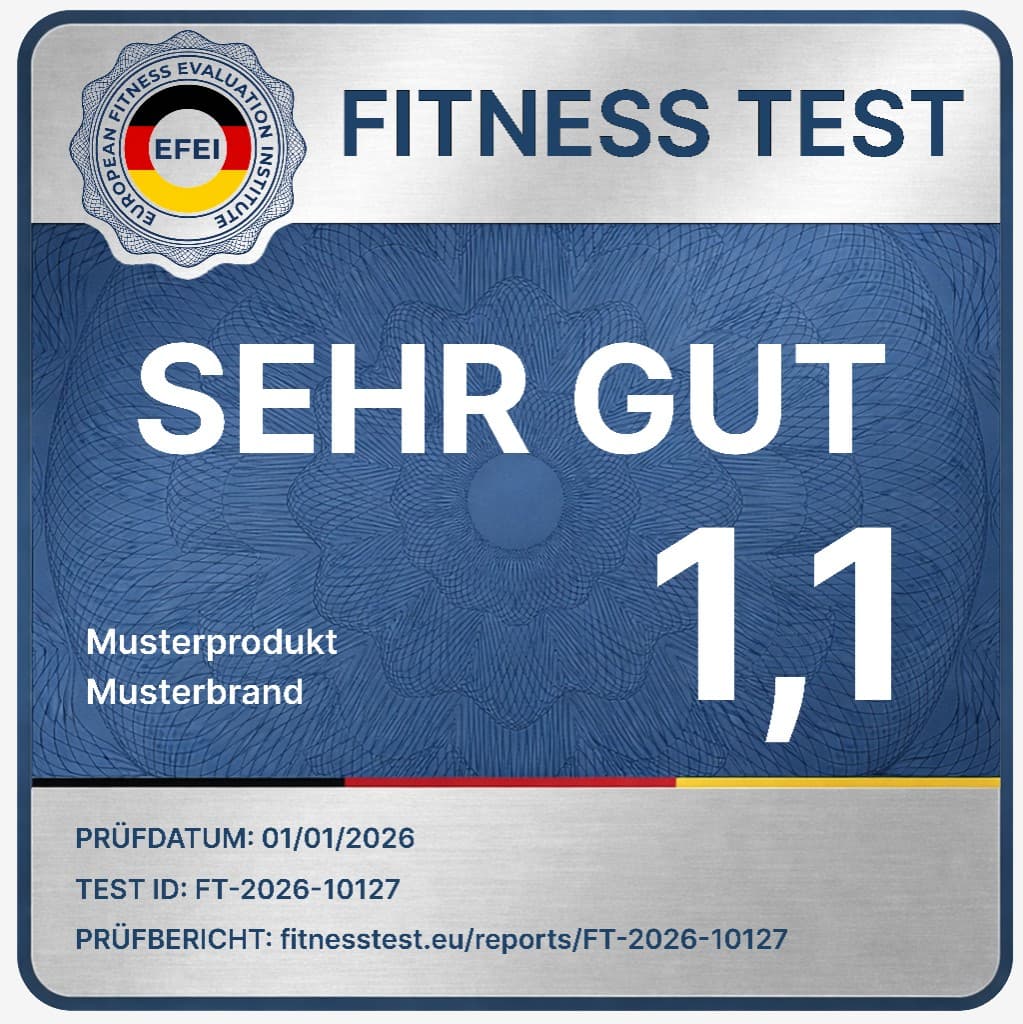
| 1.0 – 1.5 | Sehr gut | FitnessTest Certified™ — Very good |
| 1.6 – 2.5 | Gut | FitnessTest Certified™ — Good |
| 2.6 – 3.5 | Befriedigend | FitnessTest Certified™ — Verified |
| 3.6 – 4.0 | Ausreichend | FitnessTest Certified™ — Performance Tested |
| 4.1 – 5.0 | Nicht ausreichend | Not certified (result still published) |
7. Reporting requirements
Every published evaluation must include at minimum:
- Product identification, category, and annex references.
- Dimension scores, base score, expert score, and comprehensive score with rounding notes.
- Certification decision and effective programme tier (if certified).
- Summary of key evidence or links to controlled artefacts where confidentiality allows.
- Statement of independence and version of EFEI-02001 applied.
8. Document control
FitnessTest maintains this standard and its annexes. Each amendment receives a semantic version, effective date, and change log. Annual governance review ensures alignment with laboratory capability, regulatory evolution, and consumer transparency expectations.
Annex A — Base score procedures (normative)
Execute the following steps for every dimension. Deviations require written approval from the technical director and must be disclosed in the evaluation report.
Part 1 — Safety & Materials
Weight in base score: 24% (w = 0.24)
- Identify product type and applicable standards — Record the product category and applicable safety frameworks (e.g. strength/cardio machinery norms, low-voltage or radio equipment where relevant, and market-specific chemical or material rules).
- Physical hazard assessment — Inspect pinch and entrapment points, stability and tip-over risk, sharp edges, guards for moving parts, and emergency stops where applicable. Document pass/fail with dated photographs.
- Materials and chemical compliance review — Collect manufacturer declarations (REACH, restricted substances, coatings). Commission or reference third-party screening where the protocol requires it.
- Structural and surface integrity — Examine welds, fasteners, load-bearing joints, and surface finish for defects that could compromise safety or accelerate failure.
- Dimension score (1–5) — No critical non-conformities and strong alignment with requirements → 1–2. Isolated minor issues → 3. Significant gaps → 4. Critical failure or prohibited risk → 5.
Required evidence
Signed checklists, annotated photographs, declaration and test reports, incident notes.
Scoring rubric (1–5)
1–2: Meets or exceeds safety and materials expectations. 3: Minor findings. 4: Major concerns. 5: Unacceptable risk or critical non-compliance.
Part 2 — Performance & Data Accuracy
Weight in base score: 22% (w = 0.22)
- Capture all marketed performance claims — Extract rated load, speed, power, resistance curves, accuracy claims for sensors, battery life, and any quantitative marketing figures tied to the tested configuration.
- Mechanical and functional performance tests — Run instrumented tests appropriate to the category; compare measurements to claims and record tolerance bands defined in the test plan.
- Sensor and data-path verification (if applicable) — Validate outputs (e.g. heart rate, cadence, power estimates) against calibrated references; assess drift, latency, and consistency across sessions.
- Environmental and edge-case sampling — Repeat priority measurements under declared operating conditions; note sensitivity to temperature, humidity, or power state where relevant.
- Dimension score (1–5) — Claims within agreed tolerance → 1–2. Small deviations → 3. Systematic or misleading divergence → 4–5. Non-electronic products: score mechanical performance only.
Required evidence
Claim matrix, raw and summary measurement tables, calibration certificates, test logs.
Scoring rubric (1–5)
1–2: Strong alignment between claims and measurement. 3: Acceptable minor deviation. 4–5: Material inaccuracy or unsupported claims.
Part 3 — Durability & Longevity
Weight in base score: 18% (w = 0.18)
- Define endurance profile — Select cycle count, load level, and duty cycle from the category annex or approved lab protocol; document rationale when a variant is used.
- Baseline documentation — Record geometry, torque checks, noise baseline, and imagery before cycling. Define objective pass/fail criteria for the endurance leg.
- Execute endurance programme — Run the full cycle plan; log interruptions, adjustments, and intermediate inspections.
- Post-endurance inspection — Repeat key measurements; classify wear modes; estimate residual life or recommend re-test triggers if partial failure occurred.
- Dimension score (1–5) — Comfortable margin beyond target with minimal wear → 1–2. Meets target → 3. Borderline wear or early warning signs → 4. Failure before target → 5.
Required evidence
Approved test plan, cycle counter logs, photographic series, failure analysis if applicable.
Scoring rubric (1–5)
1–2: Robust durability. 3: Adequate. 4: Concerning wear. 5: Premature structural or functional failure.
Part 4 — Usability & Experience
Weight in base score: 20% (w = 0.2)
- Assembly and first-use path — Follow the supplied instructions without manufacturer assistance; log time, tools required, ambiguities, and safety warnings encountered.
- Adjustment, storage, and daily operation — Evaluate intuitiveness of adjustments, locking mechanisms, folding behaviour, footprint, and maintenance access.
- Documentation and labelling — Review manuals, quick-start guides, on-device labels, and digital companion apps for clarity, completeness, and legally required warnings.
- Acoustic and vibration characterisation — Measure or subjectively rate noise and vibration under representative workloads; flag nuisance levels for residential or studio contexts.
- Declared user range — Check stated height, weight, and limb-length envelopes against adjustability actually available on the sample.
- Dimension score (1–5) — Aggregate sub-scores using the rubric in the evaluation workbook; map the composite to the 1–5 band with written justification.
Required evidence
Assembly timeline, checklist outcomes, manual annotations, sound notes, ergonomics worksheet.
Scoring rubric (1–5)
1–2: Straightforward, quiet, well documented. 3: Minor friction. 4–5: Confusing, loud, or incomplete guidance.
Part 5 — Ergonomics & Movement Fit
Weight in base score: 16% (w = 0.16)
- Define primary use case — Document intended training modality, skill level, and representative anthropometrics for the evaluation.
- Range of motion and joint alignment — Assess whether the equipment supports neutral joint tracking or forces compensations that elevate injury risk.
- Load distribution — Evaluate pressure on hands, feet, seat, or back; flag asymmetric or excessive local loading.
- Comfort and strain indicators — Use structured expert rating or instrumented proxies where available; note red-flag postures.
- Dimension score (1–5) — Natural, balanced loading with comfortable margins → 1–2. Acceptable compromises → 3. Poor fit or elevated risk → 4–5.
Required evidence
Use-case brief, ROM worksheets, load diagrams, risk commentary.
Scoring rubric (1–5)
1–2: Strong movement fit. 3: Adequate. 4–5: Awkward mechanics or elevated strain.
For programme economics, turnaround tiers, and subscription mechanics, see the public pricing overview. For institutional background, use the methodology hub.